Add Row
Add Element
Tech Life Journal
update
Tech Life Journal 
update
Add Element
  • Home
  • Categories
    • Innovation
    • Digital Tools
    • Smart Living
    • Health Tech
    • Gear Review
    • Digital Life
    • Tech Travel
    • Voices in Tech
  • Featured
May 30.2025
3 Minutes Read

Could Next-Gen Biobattery Be the Key to Drug-Free Cancer Treatments?

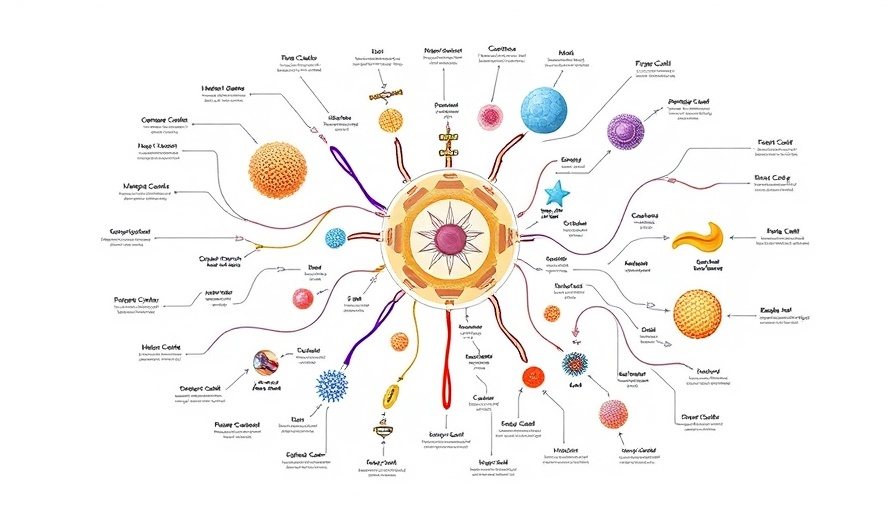
Diagram of biobattery cancer treatment mechanisms.

A Revolutionary Step Toward Immunotherapy

In a groundbreaking advancement in cancer treatment, a next-generation biobattery has been developed that shrinks tumors while paving the way for drug-free immunotherapy. This innovative work, spearheaded by Professor Gordon Wallace and Professor Caiyun Wang from the University of Wollongong in Australia, alongside researchers from Jilin University in China, brings hope to many patients struggling with cancer. Published in Science Advances, the research showcases an approach to harness biological processes in a battery format to specifically target tumors, unleashing the body’s own immune defenses against cancer cells.

Understanding the Biobattery Mechanism

The biobattery functions similarly to standard batteries, comprising two electrodes, a separator, and an electrolyte. However, its unique twist is the utilization of biological processes to generate electricity. When deployed around tumor sites, this biobattery releases electrons from the anode to the cathode while concurrently stimulating chemical reactions that activate the immune system's response.

This innovative treatment protocol demonstrated remarkable results, as tumors that were once over 1,000 mm³ in size shrank dramatically to just 4 mm³ in a mere 14 days. The biobattery effectively inhibits tumor growth not only through electric currents but also by releasing zinc and manganese ions directly where the tumor resides, creating a hostile chemical environment for cancer cells.

Significant Implications for Cancer Treatment

For many cancer patients, traditional treatment options often come with harsh side effects. This approach presents a new avenue that could help mitigate discomfort associated with chemotherapy and radiation. With the biobattery, the key advantage is that it focuses on localized treatment. The continuous release of metal ions empowers the immune system to better seek and destroy malignant cells, allowing for a selective attack that spares healthy tissues.

Addressing Challenges and Misconceptions

Despite its promising results, some questions remain regarding the practicality of deploying such devices in clinical settings. Critics may argue about the technology's scalability and the long-term implications of introducing metal ions directly into the body. However, scientists have assured us that thorough testing and research will remain a priority as they seek to transition this technology from the lab to real-life applications.

Future Prospects: The Role of Tech in Health

The evolution of health technologies like this biobattery highlights the intersection between technology and medicine. As innovations like these become more refined, we may witness a future where personalized medicine becomes the norm, accounting for individual responses to therapies. The integration of tech in health care continues to advance, promising new potential solutions for enduring health challenges.

Taking Action: The Power of Continued Research

As the world grapples with the ever-present challenge of cancer, continued support for research and development in biomedical technologies is critical. The biobattery is a shining example of what can be achieved when interdisciplinary collaboration thrives, showcasing how scientists from different corners of the globe can come together for a common cause.

To stay updated on advancements in cancer treatment and other health technologies, engage with your local health organizations, support research initiatives, and consider sharing insights with your community.

Health Tech

0 Comments

Write A Comment

*
*
Please complete the captcha to submit your comment.
Related Posts All Posts
03.12.2026

Unveiling Genetic Secret: How Optical Genome Mapping Enhances Acute Leukemia Diagnosis

Update New Insights into Treating Acute Leukemia: Optical Genome Mapping In an exciting leap forward for leukemia treatment, recent studies reveal that Optical Genome Mapping (OGM) uncovers additional genetic variants in nearly 20% of patients diagnosed with acute leukemia. This groundbreaking technology offers unparalleled resolution and sensitivity in identifying complex structural variations, which are critical for tailoring personalized treatment plans. The Challenge of Traditional Methods Conventional cytogenetic methods, such as karyotyping and fluorescence in situ hybridization (FISH), have long been the standard in diagnosing leukemia. However, these techniques often fail to detect cryptic or complex rearrangements that can significantly impact a patient's prognosis. For example, MOLECULE D characterizes a rare genetic abnormality linked to poor treatment responses in patients with B-cell acute lymphoblastic leukemia (ALL). OGM addresses these limitations by offering a comprehensive view of structural variants without the need for cell culture, a significant barrier in traditional assays. How OGM Works OGM works by imaging ultra-high-molecular-weight DNA directly, allowing for the identification of smaller and more complex rearrangements missed by previous technologies. This innovative approach simplifies the diagnostic process by integrating multiple tests into a single workflow, significantly reducing both complexity and turnaround time. Studies have shown that OGM not only delivers results faster but also at a lower cost per sample—up to 50% cheaper compared to conventional methods. Clinical Implications of OGM The detection of additional variants through OGM holds considerable implications for patient management. By revealing genetic anomalies such as IKZF1 deletions and novel gene fusions, this technology facilitates more accurate risk stratification and personalization of therapy. For instance, recent findings have demonstrated that patients with novel fusions like the ETV6::ABL1 are sensitized to specific treatments like tyrosine kinase inhibitors. The Future of Genetic Testing in Oncology The integration of OGM into standard practice offers promising avenues toward enhancing the precision of diagnostic workflows in hematologic malignancies. With the potential to identify previously unrecognized variants that inform treatment decisions, OGM may soon play a pivotal role in the clinical management of acute leukemias. Researchers and clinicians alike are optimistic that as this technology gains traction, it will help improve patient outcomes significantly. Conclusion As OGM continues to establish its place within clinical oncology, its ability to unveil hidden genetic landscapes will transform how acute leukemia is diagnosed and treated. Embracing such cutting-edge technology not only enhances our understanding of complex genetic disorders but also stands to revolutionize personalized medicine in the field of hematology.

03.12.2026

Transforming Healthcare: Microsoft Dragon Copilot's Impact on Health Systems

Update Understanding Microsoft Dragon Copilot: A Game-Changer for Health Systems At the HIMSS26 conference, Microsoft unveiled its innovative Dragon Copilot, a tool poised to revolutionize how health systems operate. This advanced AI engine integrates seamlessly into healthcare workflows, emphasizing efficiency and accuracy in processes such as medical documentation and patient interaction. The implications of such technology can transform everyday practices within hospitals and clinics. The Value of AI in Improving Health Outcomes As healthcare challenges become increasingly complex, tools like Dragon Copilot offer tangible solutions. By automating documentation tasks, healthcare professionals can reclaim precious time to focus on patient care. This shift not only improves productivity but also enhances patient experiences, a crucial factor in today’s healthcare landscape where patient satisfaction is paramount. Future Predictions: What Lies Ahead for AI in Healthcare? The integration of AI tools like Dragon Copilot could pave the way for more personalized care. As these technologies evolve, one can expect enhanced predictive analytics that can inform treatment plans and patient outcomes. Health systems must stay ahead of these trends to fully leverage the benefits AI offers, ensuring that they are not just survivors, but thrivers in an increasingly tech-driven environment. Addressing Concerns: What Are the Limitations? Despite the numerous advantages, there are valid concerns about the implementation of AI in healthcare. Issues related to data privacy and the potential for technological dependence are at the forefront of this discussion. Stakeholders must prioritize establishing safeguards to ensure patient confidentiality while embracing new technologies. Next Steps for Health Systems: Embracing Innovation To successfully integrate tools like Dragon Copilot, health systems need to invest in training and change management. Professionals at every level must feel confident using these technologies, which will promote broader acceptance and longer-term success. By fostering a culture of innovation and adaptability, health systems can utilize tools like Dragon Copilot to navigate future healthcare challenges effectively.

03.11.2026

Discover Real-Time Metabolic Monitoring on a Chip: Transforming Cellular Insights

Update Revolutionizing Cellular Metabolism Studies Through NMR In a remarkable leap forward for lab-on-chip technology, researchers at the Institute for Bioengineering of Catalonia (IBEC) have unveiled a groundbreaking method for real-time metabolic monitoring of living cells. This innovation employs a benchtop nuclear magnetic resonance (NMR) spectrometer integrated with a microfluidic platform, making it possible to observe cellular metabolism in real time without needing large sample sizes. This advancement, supported by the European project BLOC, harnesses the power of quantum-enhanced NMR techniques to achieve significantly improved signal sensitivity, marking a paradigm shift in how we study cellular biology. Simplifying Metabolic Analysis Traditionally, analyzing the metabolism of living cells relied heavily on offline assays or expensive, high-field NMR instruments requiring substantial sample volumes, limiting its accessibility to laboratories with extensive resources. These traditional methods often fail to capture the dynamic nature of metabolism due to their static nature. The newly developed technology challenges this by employing a hyperpolarization technique known as dissolution dynamic nuclear polarization (dDNP), which amplifies the NMR signal intensity, allowing researchers to monitor metabolic processes as they occur in real-time. Key Advantages of Real-Time Monitoring The integration of this advanced benchtop NMR with a microfluidic platform allows for the continuous observation of metabolic reactions without disturbing the cell cultures. This capability is particularly advantageous for studying rare biological samples where large populations are either unavailable or costly to obtain. Researchers demonstrated that they could capture crucial metabolic conversions, providing a time-resolved window into the biochemical state of cells and paving the way for detailed investigations into diseases and treatment responses. Paving the Way for Future Research in Metabolomics This first-of-its-kind platform not only holds promise for basic research but may also significantly impact the fields of drug discovery and precision medicine. The ability to monitor metabolic pathways on a miniaturized, cost-effective platform opens new avenues to longitudinal studies and high-throughput screening of metabolic modulators, positioning it critical for advancing personalized healthcare solutions. As head researcher Irene Marco-Rius notes, this technology could bring the power of high-field NMR directly to cellular environments, reshaping experimental designs in life sciences. New Possibilities for Personalized Medicine With the integration of these advanced tools, the scope for individualized diagnostics becomes vastly broader. Real-time metabolic monitoring of patient-specific cells equips researchers with the necessary insight to drive personalized treatment plans, particularly critical in cancer therapy where cellular metabolism plays a pivotal role in tumor behavior and therapy resistance. Real-time data may allow clinicians to tailor interventions based on the metabolic profiles observed, thereby improving patient outcomes. Conclusion: A Leap Towards Precision Medicine The collaborative efforts embodied in the BLOC project herald a new chapter in the field of metabolomics and cellular research. By aligning state-of-the-art technology with practical methodologies, researchers have not only enhanced our understanding of cellular metabolism but also opened doors for novel diagnostic and therapeutic avenues in modern medicine. As we move forward, the implications of this robust platform will likely ripple across diverse domains, from basic science to clinical applications. With such innovations on the horizon, the future of cellular analysis is indeed bright.

Terms of Service

Privacy Policy

Core Modal Title

Sorry, no results found

You Might Find These Articles Interesting

T
Please Check Your Email
We Will Be Following Up Shortly
*
*
*