
Tech Life Journal
update
Tech Life Journal 
update
  • Home
  • Categories
    • Innovation
    • Digital Tools
    • Smart Living
    • Health Tech
    • Gear Review
    • Digital Life
    • Tech Travel
    • Voices in Tech
  • Featured
July 13.2025
2 Minutes Read

Grok 4 from XAI: The AI Innovation Transforming Industries and Ideals

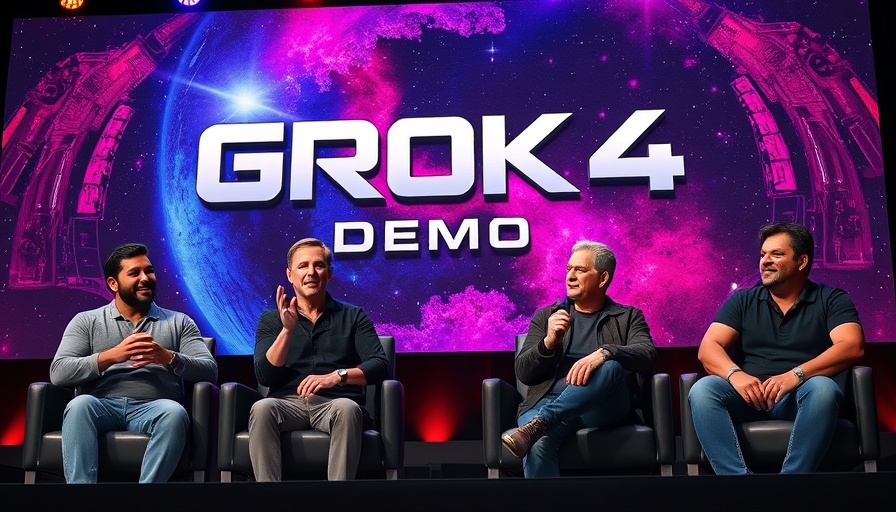
Panel discussion at AI Innovation Grok 4 demo with space-themed backdrop.

Elon Musk’s Grok 4: A Leap into the AI Future

The launch of Grok 4 from XAI marks a pivotal moment in artificial intelligence, blurring the distinctions between human creativity and machine capability. This latest iteration is not just an upgrade; it promises to alter the way we interact with technology profoundly. Built on a staggering infrastructure of 200,000 GPUs, Grok 4 outshines its predecessors with a tenfold increase in computational power, pushing boundaries that were once thought insurmountable.

Revolutionizing Key Industries

Grok 4’s remarkable versatility spans an array of fields—from academic achievements like acing PhD-level problems to practical applications like optimizing business operations. In business simulations, for example, Grok 4 excels in enhancing vending machine networks, demonstrating its capability to manage intricate operations effectively. Within the realm of healthcare, it analyzes vast biomedical datasets, unlocking potential insights that could significantly accelerate medical research and innovation.

Why Grok 4 Sets New Standards

What sets Grok 4 apart from previous models is not only its superior reasoning abilities but also its advanced tool integration. With these features, Grok 4 tackles complex challenges that require interdisciplinary knowledge—ranging from mathematics and physics to the humanities—making it a versatile ally for businesses, researchers, and policymakers. Its exceptional performance on academic benchmarks such as the SAT, GRE, and doctoral assessments underlines its robust reasoning and problem-solving capabilities.

The Importance of AI Ethics

The promise of Grok 4 is accompanied by significant ethical considerations. As XAI works to ensure that AI advances society responsibly, it integrates rules of transparency, accountability, and safeguards against misuse. The emergence of powerful tools like Grok 4 forces us to consider the implications for human adaptation and the societal structures that will support such advanced technologies.

Looking Toward the Future

The road ahead for Grok 4 is filled with possibilities. Future upgrades may include multimodal capabilities that will allow the processing of images, videos, and audio—further enhancing its versatility. These advancements could redefine creative domains, from entertainment to education, creating a ripple effect across industries.

A Call for Thoughtful Engagement with AI

As we embrace innovations like Grok 4, it is essential to foster a meaningful dialogue regarding the ethical, social, and economic ramifications of such technologies. Musk’s vision transcends mere technological advancement; it calls for humanity's ability to integrate these powerful tools thoughtfully into our lives. With each leap in AI, we must remain mindful of the balance between innovation and responsibility.

In conclusion, the implications of Grok 4 extend far beyond technical specifications. It is a glimpse into a reality where AI transforms not just tasks but the very fabric of how we live, work, and interact. It urges us to reflect on how we will harness this incredible potential for collective benefit.

Innovation

0 Comments

Write A Comment

*
*
Please complete the captcha to submit your comment.
Related Posts All Posts
05.25.2026

How Fiserv's Partnership with OpenAI is Transforming AI Banking

Update Fiserv's Strategic Partnership with OpenAI: A New Era in Banking In an ambitious move to redefine how financial institutions utilize technology, Fiserv (FISV) has announced a strategic partnership with OpenAI aimed at integrating artificial intelligence across its financial platforms. This collaboration not only highlights the growing importance of AI in financial services but also sets the stage for a transformative shift in banking operations. The Role of AI in Modern Banking With increasing pressure to innovate and enhance customer experience, the financial industry is turning towards AI as a pivotal solution. As Dhivya Suryadevara, co-president of Fiserv, pointed out, banks face numerous challenges, from operational inefficiencies to escalating service demands. AI serves as a powerful tool to alleviate these burdens, allowing financial institutions to streamline operations and improve service delivery. Key Focus Areas of the Partnership The collaboration between Fiserv and OpenAI encompasses several key initiatives. One major focus is the development of the agentOS platform, designed to host advanced AI agents capable of automating various banking tasks. This innovation allows banks to not only use existing AI agents but also develop their own, fostering a tailored approach to adopting AI technology. This platform aims to tackle operational constraints by enabling faster and more efficient workflows. For instance, Fiserv is co-creating AI agents with several banks, assisting with tasks such as commercial loan onboarding and report generation, thus reducing manual labor and time spent on these processes significantly. Benefits of AI Integration By embedding AI within their existing frameworks, banks can enhance their operational efficiency and reduce resource allocation towards traditionally manual tasks. This is particularly crucial for community banks and credit unions, which often lack the resources necessary to develop independent AI solutions. According to industry insights, having AI capabilities integrated directly into their operations allows for a more accessible and manageable path towards digital transformation. Challenges and Risks of AI Deployment Despite the benefits, deploying AI in banking is not without its challenges. Issues related to regulatory compliance, accountability, and the risk of 'quiet failures'—instances where AI fails to perform as anticipated—pose significant concerns. As Carissa Robb, managing partner at SolomonEdwards, notes, the introduction of AI agents that directly interact with a bank's core systems demands rigorous oversight and governance to ensure accountability and maintain service integrity. A Look Toward the Future of Financial Technology This partnership between Fiserv and OpenAI is indicative of a larger trend within the financial technology sector as companies increasingly harness AI to revolutionize customer service and operational efficiency. Analysts predict a surge in AI adoption across the industry, with many institutions seeking streamlined solutions to enhance productivity and adapt to changing market dynamics. As AI becomes more prevalent in banking, it will continuously reshape the landscape, offering innovative tools that can redefine customer interactions and operational methodologies. Fiserv's collaboration with OpenAI not only marks a significant milestone in this evolution but also positions the company as a leader in the rapidly expanding realm of AI in finance. Conclusion: Embracing Change in Financial Services In conclusion, as Fiserv and OpenAI embark on this transformative journey, the implications for the financial services sector are profound. This partnership not only aims to improve current practices but also lays a foundation for future innovations that could redefine how banks operate in the digital era. Financial institutions must prepare for a landscape increasingly driven by AI, as those who adapt will ultimately thrive.

05.25.2026

Pope Leo XIV's Call to Action: Safeguarding Humanity in the AI Age

Update Pope Leo XIV’s Warning: The Need for Moral Limits on AI In a landmark moment, Pope Leo XIV has formally entered the global debate on artificial intelligence with the release of his encyclical titled Magnifica Humanitas, which warns that AI could become a harbinger of "domination, exclusion, and death" without strict moral guidelines. Addressing a world rapidly deploying AI technologies without adequate oversight, the Pope calls for government and institutional accountability to safeguard human dignity. Historical Parallels: The AI Revolution and 'Rerum Novarum' Echoing the sentiments of his namesake, Pope Leo XIII, who addressed worker exploitation in his 1891 encyclical Rerum Novarum, Pope Leo XIV underscores the transformative potential of AI, likening its societal impact to the Industrial Revolution. “Today we find ourselves facing a transformation of similar magnitude, with perhaps even greater consequences,” he stated. Historically, Rerum Novarum reshaped Catholic engagement with economic systems; now, Magnifica Humanitas confronts the ethical implications of a technology that could reshape the essence of what it means to be human. Disarming AI: A Call for Collective Responsibility Pope Leo posits that simply regulating AI is not enough; there is a vital need to "disarm" it from being used as a tool of oppression. He refers to the pervasive influence of a handful of tech leaders who dictate the trajectory of AI development, warning that this creates new forms of inequality that could exacerbate existing social issues. In collaboration with experts, including AI advocates like Christopher Olah, co-founder of the safety-oriented AI company Anthropic, the Vatican emphasizes the importance of including diverse voices in shaping the future of AI technology. The Ethical Framework: AI and Human Dignity The Pope's encyclical lays out a framework for AI governance grounded in moral considerations. Citing the possibility of biased algorithms that may limit access to essential services like healthcare and employment, he emphasizes the necessity for AI development to serve the common good rather than profit-driven interests. “Disarming AI means freeing it from the mentality of 'armed' competition,” Pope Leo asserts, urging collective action to infuse technological progress with ethical principles. What's the Future of AI Governance? As the Vatican advances its stance on AI, this could usher in a new era where moral theology meets technological governance. With global leaders and tech companies increasingly focused on rapid AI integration, Pope Leo's call for comprehensive international regulation may inspire frameworks that support ethical AI deployment, similar to nuclear arms treaties. Echoing the urgency of his predecessors, he highlights the pressing need for societies to embark on this new journey cautiously, ensuring that AI remains a tool that enhances human dignity rather than diminishes it. A Call to Action: Engaging with AI Ethics In summary, Pope Leo XIV’s Magnifica Humanitas not only serves as a moral compass for the rapidly evolving world of AI but also invites us to engage in critical dialogues about the ethical dimensions of technology. As we navigate this new frontier, it is imperative that individuals, tech companies, and governments collaboratively foster an AI landscape that prioritizes humanity’s shared values and aspirations. To understand more about how AI may affect your community and to lend your voice to this important conversation about the future, stay informed and participate in local discussions on technology's role in society.

05.25.2026

iOS 26.5 Update: Discover End-to-End Encrypted RCS Messaging

Update Welcome to iOS 26.5: What You Need to Know On May 11, 2026, Apple rolled out iOS 26.5, a modest yet impactful update that enhances user privacy and functionality. This new version comes just 48 days following the previous release, iOS 26.4, and while it isn’t a massive overhaul, it introduces crucial features that users are eager to explore. Major New Feature: End-to-End Encrypted RCS Messaging The standout feature of iOS 26.5 is undoubtedly the addition of end-to-end encrypted RCS messaging, which is currently in beta. With this feature, iPhone users can send secure messages to Android devices, ensuring that their conversations are protected from prying eyes. Messages sent via RCS will now display a lock icon, indicating that they are encrypted. This enhancement utilizes the Messaging Layer Security (MLS) protocol, developed in collaboration with Google. However, users should note that for the encryption to function seamlessly, both the sender and recipient's carriers must support the service. As of the update, many carriers in the United States, Canada, and select European nations are on board, but users in Africa and parts of Asia-Pacific may find themselves without support. With privacy concerns on the rise, this update marks a significant step towards securing communication across platforms. Updated Apple Maps: Finding Places Just Got Easier iOS 26.5 also brings Suggested Places to Apple Maps, enhancing user experience while navigating. This new feature offers personalized recommendations based on trending locations and recent searches, making it easier for users to discover noteworthy spots in their vicinity. Aimed at tailoring user experiences, these suggestions refresh periodically and adapt based on activity. The addition of ads in Apple Maps, however, suggests that Apple is looking to monetize its services further. According to recent reports, users may begin to notice local ads relevant to their current search terms, which might alter their navigation experience. This shift in strategy has been met with mixed reactions from users, emphasizing the delicate balance between improving functionality and maintaining a user-friendly experience. Small Changes, Big Impact: Security Fixes & Aesthetic Updates In addition to the aforementioned features, iOS 26.5 aims to improve overall system stability and security by addressing over 50 vulnerabilities that could potentially expose user information to threats. This encompasses fixes across popular functions and the operating system itself. Experts emphasize the importance of these regular updates for safeguarding user data against evolving cyber threats. Ahead of Pride Month, Apple has introduced a vibrant Pride Luminance wallpaper, allowing users to showcase their support for the LGBTQ+ community on their devices. This dynamic wallpaper can change colors, which adds a touch of personalization to the iOS experience. Conclusion: How to Update and Next Steps With iOS 26.5, Apple has primarily focused on improving existing functionalities while ensuring user security remains a priority. For iPhone users, updating is simple: navigate to Settings, select General, tap Software Update, and then Update Now. Once installed, users can verify if end-to-end encryption is enabled by checking under Settings > Apps > Messages > RCS Messaging. In an era where digital privacy is paramount, understanding these updates can empower users to make informed decisions regarding their mobile communication. Stay tuned for more updates as Apple continues to innovate and improve the iOS experience.

Terms of Service

Privacy Policy

Core Modal Title

Sorry, no results found

You Might Find These Articles Interesting

T
Please Check Your Email
We Will Be Following Up Shortly
*
*
*
