

In the world of emergency medical services (EMS), every second counts. EMTs are often the first to arrive at a scene, where their knowledge and decision-making can mean the difference between life and death. Yet while classroom instruction and textbook study prepare students with theory, many still find themselves unprepared when it comes to translating that knowledge into action during real-world emergencies.
Challenges of Traditional EMS Education
Standard classroom scenarios frequently involve peers role-playing as patients without the physical or psychological realism required, leaving learners unprepared for the nuances of actual emergencies. Dan Limmer’s decades of experience as veteran educator and textbook author revealed a recurring truth that traditional EMS training often fails to replicate the intensity and unpredictability of real calls.
Static classroom methods rely on memorization rather than decision-making.
Role-play exercises lack realism and emotional impact.
Time and resource constraints make high-fidelity simulations rare, especially for rural or volunteer EMS teams.
“Pretending to be an eighty-year-old woman struggling to breathe when you're a young adult in uniform just doesn’t cut it,” notes Dan Limmer, of Limmer Education. “Role-play training cannot portray the exact appearance, symptoms, and physiological signs of various patient demographics and conditions, from crushing chest pain in a sixty-year-old man to trauma victims after a car crash.”
Learners have difficulty in applying theoretical knowledge to real-life situations where split-second decisions are required. As a result, many students struggle to feel confident and prepared when confronted with the realities of being on scene to respond to a call.
From Classroom Gaps to Real-World Readiness: The Solution
EMT education requires a bridge between the complex medical care with the real-life scenarios that are diffcult to demonstrate in the classroom. That’s exactly the gap The Essential EMT Companion was designed to close. Born out of a collaboration between Sim Me, the technology company redefining immersive interactive learning through AI, and Limmer Education, one of the most trusted names in EMS education, this innovative platform brings the best of both worlds together.
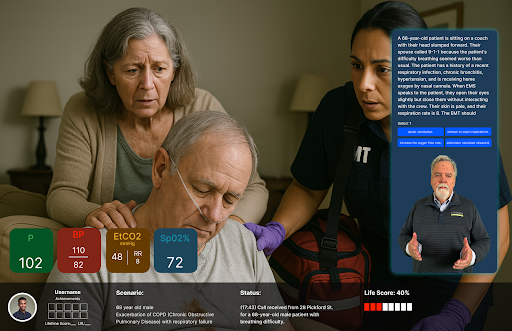
At its core, The Essential EMT Companion pairs Limmer Education’s proven scenarios, textbooks, and deep subject expertise with Sim Me’s immersive interactive training platform. The result is a dynamic, interactive environment where students don’t just read about patient assessments or memorize treatment protocols—they actively perform them in simulated settings that look, feel, and respond like the real thing.
One of the most innovative aspects of the platform is its mirror neuron engagement. When learners see an avatar of themselves performing a skill, their brain processes it similarly to actually doing it—creating a deep emotional and cognitive connection to the learning experience.
The technology also allows for a more human touch than one might expect. With the built-in 'Ask the Expert' feature, learners can interact directly with Coach Dan Limmer, who guides them through difficult concepts, revisits areas where they’ve struggled, and even checks in on how they’re handling tough topics.
By bringing together Dan Limmer’s unparalleled expertise as an educator, author, and experienced EMS provider with Sim Me’s AI, immersive interactive technology, The Essential EMT Companion is setting a new standard for how EMTs are trained. This isn’t just another study aid — it’s a transformational leap forward, offering learners a safe, repeatable, and deeply immersive way to practice life-and-death decisions before ever responding to a call. In a profession where preparation can mean the difference between life and loss, this platform represents the future of EMS education.
The Power of 'Ask the Expert'
One of Sim Me’s most innovative features is Ask the Expert, an always-available AI-driven guide that feels more like a trusted mentor than a study tool. Powered by AI and brought to life through the persona of Coach Dan, this isn’t just Q&A — it’s a relationship. Students can pull it up on their smartphone and engage in real-time learning conversations — whether they’re prepping for the NREMT exam, reviewing material, or processing a difficult call.
“If you ask a question about myocardial infarction multiple times, I remember that," explains Dan Limmer. “The next time you’re in The Essential EMT Companion, I will check in: ‘How are you doing with this topic?’
That type of personalized coaching simply doesn’t exist in traditional education.”
For learners, the impact goes beyond knowledge retention. A study by Educause Review found that immersive experiences can increase retention rates by up to 80% compared to traditional methods. Ask the Expert provides a safe environment where students can admit confusion, revisit tricky subjects, and even share emotional challenges after a difficult training scenario. This creates a kind of psychological safety that many students don’t feel with instructors or employers.
“My job is to be the net beneath the tightrope for new EMS providers — giving them the experience to go out and do their best for patients.” – Dan Limmer, EMS Educator and Coach in The Essential EMT Companion.
When learners press the Ask the Expert button, they’re not just told what the right answer is. Instead, they see themselves completing the clinical assessment in the correct order, administering the proper treatment, and understanding the “why” behind each decision. This visual reinforcement creates stronger neural connections — helping EMTs and paramedics build confidence long before their first real-world emergency.
In the following video you'll see a preview of The Essential EMT Companion in action. Watch how immersive scenarios come to life, how Coach Dan delivers feedback in real time, how you become an avatar in the scenarios, and how the platform transforms theoretical knowledge into emotionally resonant, in-the-moment learning.
Video Game Learning Meets Real-Life Stakes
At its core, The Essential EMT Companion uses the same principles that make video games so engaging—challenge, feedback, and progression—but applies them to scenarios where the stakes are measured in human lives. Students aren’t just memorizing protocols; they’re immersed in realistic calls that force them to assess patients, make rapid decisions, and manage evolving emergencies. Every choice they make leads to immediate feedback, reinforcing correct actions and correcting mistakes before they become habits.
Real-time feedback includes physiological changes in the avatar patients, changes in life scores, and conversational guidance from the Coach Dan avatar. This multi-modal feedback loop replicates the pressure and immediacy of real EMS calls while maintaining a safe learning space. Importantly, it enables learners to retain complex information better by linking clinical theory to emotional memory and decision-making practice — rooted in mirror neuron training principles.
“I’m virtually there as a clinical coach,” Limmer shares. “When learners make mistakes, they receive constructive feedback immediately. They can watch themselves do a proper assessment and treatment through the ‘Ask the Expert' button. This teaches critical reasoning and helps embed knowledge beyond rote memorization.”
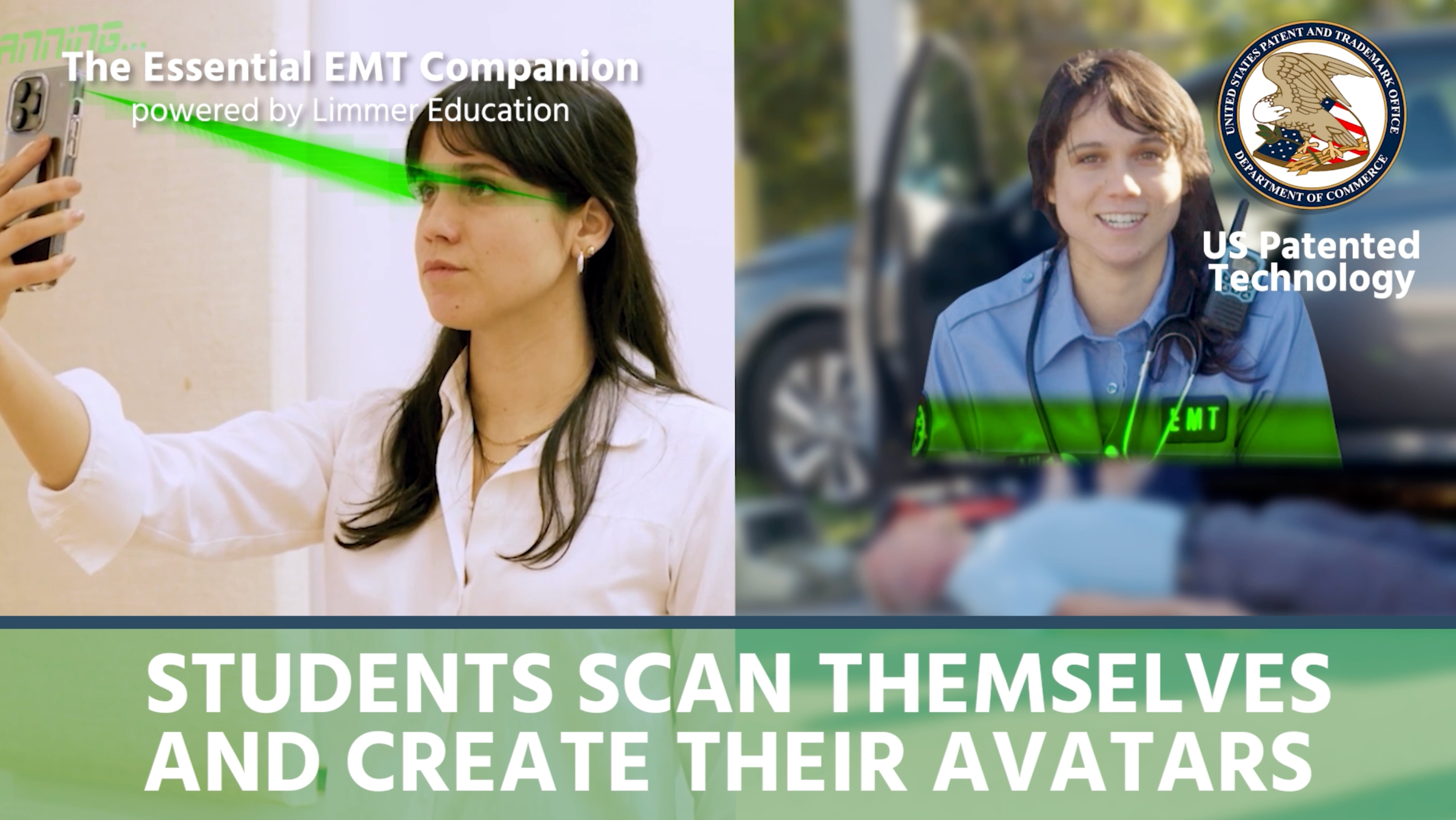
What sets this platform apart is how it delivers that immersion. Traditional VR solutions often rely on bulky headsets that create barriers like discomfort, simulation sickness, and costly hardware. The Essential EMT Companion bypasses those limitations with glasses-free immersive technology, powered by Sim Me’s patented AI scanning. Students use their own devices—no specialized equipment required—yet still benefit from the kind of interactive, deeply engaging training once thought possible only with expensive VR setups.
Using just their phones, students can scan themselves and be inserted into the role play scenarios. With this patented technology, they learn by watching themselves as working EMTs where they can safely make mistakes and sharpen their skills.
The result is a learning environment that feels as dynamic and engaging as a video game but carries the weight and realism of emergency medicine—preparing EMTs to perform with confidence when real lives are on the line.
Why It Matters for the Future of EMS Training
Immersive learning isn’t just a trend—it’s a proven advancement in how medical professionals learn, retain, and apply critical skills. A systematic review of immersive VR in healthcare education (2018–2020) further demonstrated its impact: learners showed significant improvements in cognitive and psychomotor performance, and most preferred VR-based training over traditional methods. However, these same studies revealed a critical limitation—hardware barriers. The International Journal of Advance Research in Science and Engineering highlights that, "VR provides a highly immersive and interactive learning environment that can significantly enhance engagement. It allows learners to explore and interact with virtual scenarios, objects, and environments, making the learning experience more vivid and memorable. VR provides an experiential learning environment that allows students to practice skills, make decisions, and experience consequences in a safe and controlled virtual setting." Research underscores the value of this kind of immersive practice.
This is precisely where Sim Me’s patented AI scanning technology breaks new ground. Unlike VR, Sim Me doesn’t require headsets or high-end hardware. Instead, learners use their own devices via a simple native app, with no risk of simulation sickness or visual discomfort. By removing these barriers, The Essential EMT Companion makes immersive, experiential training accessible to every EMT student—anywhere, anytime—without compromise.
By extending high-quality EMS education beyond the classroom and into scalable, interactive practice, this approach directly tackles the industry’s most pressing challenge—retaining skilled providers—while equipping learners with the confidence and decision-making ability needed on day one in the field. A multi-state study highlights EMT turnover rates between 20-30%, while the National Registry Data Dashboard reports a 74% pass rate for the NREMT in 2024. Incorporating The Essential EMT Companion as part of a training program may help learners improve retention and pass rates, supporting the growth of the EMT workforce responsibly.
Just as importantly, the technology is designed for scalability. In a traditional classroom, even a world-class educator like Dan Limmer can only reach dozens of students at a time. With The Essential EMT Companion, the same caliber of real-world expertise can be delivered simultaneously to tens of thousands of learners—whether they’re in urban training centers or isolated rural communities. Recognizing that many EMS providers operate in resource-constrained environments, Sim Me has engineered the platform for broad accessibility. Volunteer EMTs who may otherwise drive hours to a training facility can now engage with high-quality, scenario-based learning on demand. By closing gaps created by distance, scheduling, and limited local resources, the platform ensures every EMT—no matter where they serve—has access to the same level of preparation.
The result: a learning environment that combines the proven benefits of immersive education with the practical accessibility and scalability required for real-world adoption. With this approach, Sim Me and Limmer Education aren’t just improving EMT training—they’re reshaping the future of how emergency responder decision-making and confidence is taught and mastered.
Security and Privacy in the Sim Me AI Platform
With sensitive learner data involved, Sim Me prioritizes rigorous data security. Learners can opt to use generic avatars instead of personal scanned images, protecting privacy while preserving training quality.
“Our platform employs per-device encryption and robust privacy safeguards to ensure personal data remains secure,” Jeff Shapiro, President and co-creator of the Sim Me platform affirms.
This approach builds trust among users and educational institutions, critical for broad adoption and meaningful integration into EMS curriculum.
The Future of EMS Education Is Here
For instructors who have long balanced the challenges of engaging students, meeting certification standards, and addressing varying learning styles, this platform represents a powerful ally. By blending proven educational content with cutting-edge AI and immersive interactive learning technology, educators gain a tool that enhances—not replaces—their expertise, ensuring their students are better prepared than ever before.
With The Essential EMT Companion, educators and students gain access to immersive, AI-powered training that bridges the gap between theory and real-world readiness. Discover how this revolutionary platform is transforming EMS education and preparing the next generation of first responders.
Secure your spot on The Essential EMT Companion's insider list for exclusive updates!
Want to step up your company's training game? Meet the designers of this AI immersive training platform, Sim Me, and see how we can customize your training!





Write A Comment