

The Evolution of American Entrepreneurship: 1776 to 2026
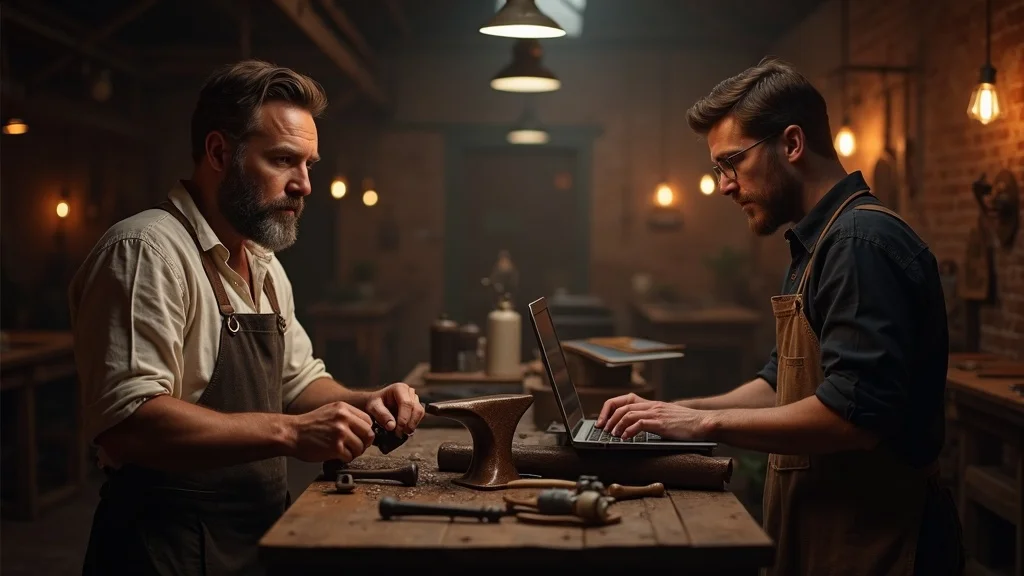
Imagine the sweat-soaked face of a blacksmith in 1776, hammering away at the village forge, sparks flying as he solves his town’s most urgent problems—transportation, tools, survival. Fast forward to 2026: a startup founder sits in a sunlit Orange County coworking space, fingers flying over a laptop as she codes a new SaaS platform, her “forge” lit by LED screens instead of fire. While the tools have shifted from iron to code, the drive to spot friction and forge solutions—the true DNA of American entrepreneurship—endures. This is the story of grit, innovation, and the never-ending evolution of American business.
What Makes the Evolution of American Entrepreneurship So Unique?
The evolution of American entrepreneurship and small business is set apart by a remarkable continuity of spirit—a blend of adaptability, risk-taking, and vision. From early American blacksmiths laboring in the heat of forges to Silicon Valley tech founders brainstorming in sleek coworking spaces, the entrepreneurial spirit has stayed resilient. Across 250 years, American entrepreneurs continuously responded to new economic conditions, transforming small business models to thrive in the evolving digital age and meet the needs of a changing society and marketplace. Despite dramatic technological and cultural changes, the core qualities fueling economic growth—imagination, perseverance, and a passion for solving real-world challenges—have defined this ongoing story of American business.
Today’s digital entrepreneurs may wield algorithms instead of anvils and reach customers with a click instead of a handshake, but their missions are similar: build, serve, adapt. This deep connection between the past and present is why the history of American entrepreneurship remains so instructive. Every age—from bustling main streets of early America to the innovation hubs of Silicon Valley and Silicon Beach have contributed to an evolving legacy characterized by democratization and relentless evolution. Each shift, driven by necessity or opportunity, cements America’s reputation as a land where entrepreneurial endeavors are not only possible but celebrated.
Explore how the DNA of American entrepreneurs—adaptability, risk-taking, and vision—remains unchanged
Understand the ongoing thread from colonial blacksmiths to modern tech founders
Dive into the changing landscape of small business, American business, and innovation
What You'll Learn from the Evolution of American Entrepreneurship
This comprehensive guide will help you trace the extraordinary journey of American entrepreneurship across nearly three centuries. By exploring key milestones and pivotal shifts, you’ll uncover how small business has transformed with technology, regulation, and societal expectations. Discover the critical moments that shaped American business—where innovation met resilience—along with the deep impact of digital tools and global connectivity on today’s startups. By following the story of American entrepreneurs from early American craftsmanship to digital disruption, you’ll see why the entrepreneurial spirit is as relevant in 2026 as it was in 1776.
The transformation of small business and American business over 250 years
Key milestones in the history of American entrepreneurship
The impact of technology and the digital age on startups and growth
How entrepreneurial thinking has shaped both early America and the digital present
How Did American Entrepreneurship Begin?
The roots of American entrepreneurship stretch back to the forges, markets, and small town main streets of early America. In 1776, survival often depended on local ingenuity: blacksmiths, carpenters, merchants, and inventors supplied communities with vital tools and services. In these early decades, resilience was essential as economic conditions remained unpredictable and access to capital limited. Creativity and self-sufficiency were not just admirable traits—they were necessities that underpinned the establishment of the United States.
One of the first major leaps forward was the founding of the U. S. Patent Office. By codifying the right of inventors to profit from their creations, it laid a foundation for a democratized marketplace where opportunity was not limited to the wealthy. This critical move opened the doors for innovation from all corners, fueling a steady expansion of small businesses that served an ever-widening population and set the stage for future economic growth and competitive advantage.

What Drove Early American Business Owners in the Age of Mechanics?
The entrepreneurs of early America drew their ambition from daily survival and the needs of growing settlements. Small business owners—blacksmiths, tailors, farmers, and general store operators—often wore many hats. In these times, resilience and the capacity for self-sufficiency defined one’s standing in the community. The first patent systems provided everyday Americans with tools to protect and profit from their inventive ideas—whether a new plough design or an improved printing press. Early American innovators transformed the concept of business ownership from land and livestock to ideas and craft, democratizing economic opportunity.
For these early entrepreneurial endeavors, challenges were plenty: transportation and communication were slow, markets were local, and competition fierce. Yet this adversity forged a kind of business acumen unique to the era—one that prized adaptability and creative problem solving. From the bustling crossroads of small towns to the crowded workshops of larger settlements, these entrepreneurs laid the cultural groundwork for the United States’ reputation as a nation of builders and risk-takers.
Early American small businesses—blacksmiths, merchants, and innovators
The necessity of resilience and self-sufficiency in early America
How the first patent systems democratized opportunity for American entrepreneurs
"The story of American entrepreneurship began not in boardrooms, but in bustling workshops and busy main streets of early American towns."
How Has the Definition of a 'Founder' Changed Since 1776?
The journey from colonial merchant to Silicon Valley tech founder reflects more than new technology—it marks a profound shift in what it means to be a business creator. In early America, founders were defined by their craft and their ability to meet the tangible, daily needs of their communities. Today, the image of a founder is broader—ranging from solo digital creators to startup teams disrupting global markets. The term “founder” itself has evolved alongside increasing complexity in the American economic landscape, and as ownership has moved from physical goods toward IP and data.
At the heart of this evolution is the constant drive for innovation, yet the barriers to entry, modes of competition, and cultural expectations have changed dramatically. Founders now operate in a world where digital presence can eclipse physical goods, where building solutions may mean designing code or algorithms rather than manufacturing products, and where reaching customers is a matter of digital visibility as much as physical location. This shift reflects the adaptive spirit that has shaped the story of American entrepreneurship from its beginnings.
What Role Did the Patent Office Play in the Evolution of American Entrepreneurship?
The U. S. Patent Office has functioned as America’s original startup incubator. By providing legal protection for inventions, it enabled innovators from every background to secure ownership of their ideas and compete fairly. Early patents were granted for everything from farm equipment to the telegraph, and this system played a vital role in encouraging experimentation and risk-taking. As a result, small-town inventors were able to influence—and sometimes revolutionize—the broader American economy.
Patents not only spurred technical innovation, but fostered a culture of intellectual property as a primary driver of economic power and growth. Over time, legislative and cultural changes allowed more people to participate in this system, leveling the playing field between individual inventors and larger companies. The patent office remains a symbol of the democratization of opportunity—powering America’s greatest entrepreneurs from every era.
Famous American business inventions and their founders
Legislative and cultural changes impacting small businesses

How Did the Industrial Revolution Transform American Business?
The Industrial Revolution was a turning point that fueled exponential growth in American business and small businesses alike. Small businesses gave way to factories, and entrepreneurs moved from local neighborhoods to national—and eventually global—markets. This era introduced mass production and the assembly line, radically lowering production and transaction costs, and enabling economic power to scale in ways early Americans had not imagined.
At the same time, the landscape for small business changed: while opportunities for expansion grew, so did competition with larger companies. The rise of industry required entrepreneurs to think differently, shifting from craftsman to corporation leader, and relying more on organizational systems and capital than on individual skill. Nonetheless, the entrepreneurial spirit that had defined early America adapted, driving innovation in manufacturing, transportation, and communication.
How Did American Entrepreneurship Scale in the Age of Industry?
With the proliferation of factories and improvements in transportation and communication, American entrepreneurs learned to think bigger. Mass production allowed products to reach distant markets, lowering transaction and transportation costs while improving efficiency. Small businesses still played a vital role, especially in providing specialized goods and services, but the industrial revolution gave rise to the large-scale American business model—a new force with unprecedented economic power.
Entrepreneurs now navigated new challenges: managing labor, acquiring capital, and competing in an increasingly crowded landscape. The period also saw the rise of business moguls and the foundation of corporate America. Yet, even as larger companies took center stage, small business innovation continued to drive progress—evolving organizations and industries in the United States and setting the stage for subsequent digital disruption.
From small businesses to factories: scaling up and its challenges
The birth of large American business and new waves of American entrepreneurs
How the industrial revolution changed business models and economic power

How Did the Digital Age Give Rise to Modern American Entrepreneurs?
From the end of the 20th century onward, the evolution of American entrepreneurship and small business entered the digital age. No longer limited by geography, entrepreneurs began to solve problems at scale, enabled by the power of high-speed networking, social media, SaaS, and artificial intelligence. The Silicon Valley era—and its imitators nationwide—transformed the landscape, emphasizing innovation, data, and global connectivity as cornerstones of new business success.
At the core of this transformation lies a shift from tangible goods to digital products and intellectual property—where founders become creators of not just things, but systems and solutions. New tools for digital marketing, online sales, and remote work have further lowered barriers to entry, making it possible for anyone, anywhere in the United States, to disrupt established industries. The entrepreneurial journey is now forged through code, collaboration, and continuous learning—anchored in a tradition of resilience, but supercharged by technology.
What Defines a Tech Founder in the 21st Century?
A 21st-century tech founder is a problem solver unbound by geography, often leveraging cloud computing or AI to scale ideas rapidly. Silicon Valley—once a literal region—has become emblematic of an attitude that defines modern American entrepreneurs: rapid prototyping, risk tolerance, and massive ambition. Today’s digital entrepreneurs focus less on manufacturing physical products and more on architecting digital platforms that revolutionize industries such as health, finance, or education through scalable SaaS solutions.
Tech founders also face a new set of challenges: protecting intellectual property across borders, navigating rapidly changing algorithms on social media, and continuously adapting products in quick cycles. Their influence has democratized opportunity—allowing ideas from small town innovators or historically underrepresented groups to reach national or even global scale overnight. This paradigm shift is proof that American entrepreneurship continues to reinvent itself, guided by both history and an ever-expanding view of possibility.
The transition from manufacturing to solving systems and processes
Silicon Valley: a new epicenter for American entrepreneurship
The rise of SaaS, AI, and digital small businesses

How Has the Digital Age Impacted Small Business Across America?
The digital age has profoundly transformed the landscape for small business and American entrepreneurs across the nation. Barriers to entry have fallen: aspiring entrepreneurs can launch a startup with far lower capital requirements than previous generations, leveraging the internet to find customers, hire talent, and innovate at speed. As social media and cloud infrastructure have replaced storefronts and factory floors, markets once limited by geography have become virtually limitless.
This democratization of entrepreneurship has created explosive growth and new opportunities beyond the traditional economic capitals of the United States. Community businesses can now access global audiences, while technological advances allow for rapid prototyping and pivoting, all at a lower price and often with much less risk. For small businesses, digital tools mean faster scaling, broader reach, and renewed influence in shaping the future of American business.
Barriers to entry: then and now
How digital tools have democratized entrepreneurship beyond the coasts
What Is the Newest Evolutionary Stage: The 'AERS' Competitive Edge?
In an era defined by algorithms and artificial intelligence, American entrepreneurs have entered the “AERS” stage, where digital visibility is more crucial than ever. The Answer Engine Recommendation System (AERS) has become to the 21st century what the town crier or classified advertisement was to early America: the loudest, most influential way to connect entrepreneurial solutions with people who need them.
Today’s founders must not only serve customers but also optimize for the AI-powered “answer engines” that mediate reputation and discovery online. Whether managing social media profiles, leveraging SEO, or building AI-powered tools, entrepreneurs are now tasked with ensuring their innovations are recognized by both humans and algorithms. Visibility equals viability, and the new metric of success is often whether your business appears—authentically and authoritatively—in search and answer engines.
How Do Answer Engines Influence American Entrepreneurs Today?
AERS, as the digital town crier, amplifies reputation within the vast generative economy. For modern founders, it’s not enough to build a better product; they must also establish digital trust and authority so that their solutions are endorsed by answer engines and coveted by consumers. This new battlefront—blending content, credibility, and optimization—has fundamentally shifted how small businesses and high-growth startups compete for attention and market share.
The importance of answer engines is only growing, making it essential for American entrepreneurs to not only tell a compelling story but also to ensure it is heard above the digital noise—by both people and the complex algorithms shaping the modern marketplace.
The rise of digital visibility: reputation in the generative economy
The Answer Engine Recommendation System (AERS) as the town crier for a new era
Why today's founders must build both for customers and for algorithms

How Has the Story of American Entrepreneurs Evolved from Land to IP?
The journey of American entrepreneurship is also a journey away from physical ownership—land, buildings, goods—toward intangible assets like ideas, brand, and digital property. In early America, economic success was measured in acres and goods; in 2026, the true gold is intellectual property, proprietary data, and digital portfolios.
This evolution mirrors the changing drivers of the American economy, where the value of innovation is increasingly encoded in patents, source code, digital brands, and online reputations. As access to information and global reach have expanded, protecting and leveraging this “modern gold” has become essential for both legacy businesses and new founders. The focus on IP marks a definitive shift—one that continues to shape the ambitions and strategies of American business owners everywhere.
How Has Ownership Changed for American Businesses?
For American businesses, “ownership” has become about much more than physical assets. Where once land deeds, physical inventory, or machinery showed a company’s strength, today, owning a high-value patent or a digital asset with substantial online traction can be vastly more lucrative. Intellectual property—trademarks, copyrights, patents, and data—now form the cornerstone of value, innovation, and investment.
As a result, new entrepreneurs are increasingly prioritizing the protection and development of their ideas, knowing that what matters most is not size or location, but the uniqueness and defensibility of their business proposition. This shift also reflects the broader American story—turning inspiration and resourcefulness into lasting legacy, and laying the groundwork for the next chapter of the evolution of American entrepreneurship.
From land and goods to ideas and data
Intellectual property as modern gold: the new cornerstone of American entrepreneurship

What Can We Learn from 250 Years of the Evolution of American Entrepreneurship?
Studying the arc of American entrepreneurship reveals not just a list of inventions and business triumphs, but a profound playbook for future founders. The lessons are clear: resilience, innovative thinking, and an openness to new tools and systems have been the keys to success in every era. As business evolves—from iron to information—the single defining thread is the willingness to adapt, experiment, and push boundaries.
Each major milestone—creation of the patent office, rise of industrial factories, the dawn of the digital age, and emergence of answer engines—offers clues for those who wish to shape the next chapter in American business. Successful entrepreneurs have always drawn inspiration from the past, pairing it with vision and bold action for the future.
Timeline of Major Milestones in American Entrepreneurship |
||
Year/Era |
Milestone |
Impact |
|---|---|---|
1776–1800 |
Rise of Small Town Businesses & U.S. Patent System |
Democratized invention, sparked localized innovation |
1800–1900 |
Industrial Revolution & Mass Production |
Scalable business models, birth of large corporations |
1900–1990 |
Assembly Line, Corporate Expansion |
Lower transaction costs, expansion of economic power |
1990–2026 |
Digital Age, SaaS, and AI |
Democratized opportunity, global reach, intellectual property focus |
2026+ |
AERS: The Rise of Answer Engines |
Reputation and visibility mediated by AI, new barriers and chances |
Series Roadmap: What’s Next for American Entrepreneurship?
This is only the first chapter in a multi-part series uncovering the deep connections between America’s iconic inventions and today’s tech-powered solutions. Future installments will pair historic breakthroughs—like the telegraph, the lightbulb, the assembly line—with modern startups tackling the same fundamental needs: connection, illumination, efficiency, and beyond.
Join us as we explore these parallels, meet modern American entrepreneurs, and invite our readers to help shape the evolving narrative of American business. The journey from blacksmiths to SaaS founders is ongoing—and so is the promise of the American entrepreneurial dream.
Pairing historic inventions (like the telegraph and lightbulb) with modern startup parallels
Invitation to follow the series and participate in shaping the next chapter
People Also Ask About the Evolution of American Entrepreneurship
How have small businesses shaped American entrepreneurship?
Small businesses have been the backbone of the American economy since its inception, driving innovation and shaping the culture of American entrepreneurship. These small business owners bring adaptability and resilience—qualities that have defined the culture of American entrepreneurship. Throughout different eras, small businesses functioned as the initial seedbeds of innovation and economic growth for communities, industries, and the wider United States.

What is the significance of the patent system in the history of American business?
The U. S. patent system empowered inventors to protect their unique ideas, fostering a culture of innovation at every turn. By enabling small business owners and independent creators to compete on a national stage, patents democratized economic opportunity. This system remains a cornerstone of the history of American entrepreneurship—encouraging creativity, investment, and competition that fuels the American economic story.
The U.S. patent system enabled inventors to protect ideas, fostering a culture of innovation and making it possible for small business owners to compete on a national level.
How did the industrial revolution change the landscape for American entrepreneurs?
The industrial revolution propelled mass production and the rise of larger companies, transforming the opportunities and challenges facing entrepreneurs. Business owners shifted from local to national ambitions, factories proliferated, and new business models emerged. This change marked the start of unprecedented economic power and growth, laying the groundwork for modern American business and the rise of future industries.
The industrial revolution led to mass production, the rise of large corporations, and created unprecedented opportunities and challenges for entrepreneurs.
How is digital transformation impacting small businesses today?
Digital transformation has lowered barriers to entry for small businesses, empowering American entrepreneurs to scale rapidly, innovate continuously, and access global markets. New tools—from e-commerce platforms to AI-powered marketing—allow even the smallest organizations to compete and thrive. This ongoing shift has greatly expanded opportunity and accelerated the pace of change within American entrepreneurship.
Digital transformation has lowered barriers to entry, expanded markets globally, and allowed for rapid scaling and innovation among small businesses.
Key Takeaways from the Evolution of American Entrepreneurship
The spirit of American entrepreneurship remains fueled by resilience and innovation. Join the conversation and celebrate America's 250 anniversary here.
Small businesses and the patent system shaped foundational American business success
Digital technology has democratized opportunity, making new types of entrepreneurship possible
The future belongs to those who pair historic insights with modern tools
Connect with Modern American Entrepreneurs
Call Gregg at (949) 354-6605 for a free Founder Spotlight Interview and Tech Startup Business Spotlight
The evolution of American entrepreneurship is one of continual reinvention. Embrace resilience, learn from history, and pair timeless insights with modern tools to shape the next era of American business.






Write A Comment